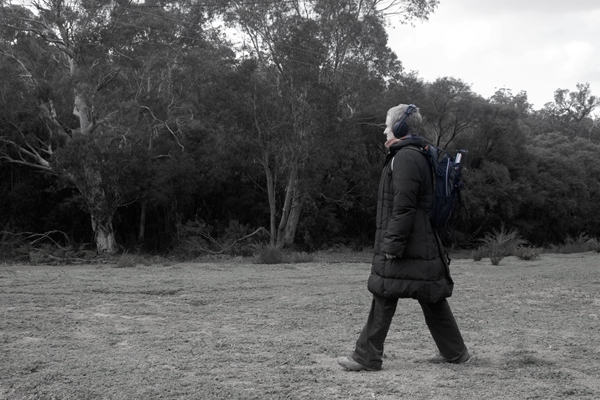
The Sixth Shore is a research and development project aiming to create an audio soundscape tour that engages with the physical and social environment whilst challenging the participants through the conceptual ‘interference’ of different levels of time and space in the soundtrack. Participants will move through fields of sounds that change over time: where people walk will determine what they hear. The culmination of the project will be the a soundscape with 4 wearable headphone/GPS units exhibited at Lake Clifton, near Mandurah, Western Australia in 2012.
The project was an artist in residence at SymbioticA, The University of Western Australia (2009-2010) and part of the larger Adaptation project produced by SymbioticA. The Sixth Shore was funded by the Inter Arts Panel of the Australia Council and the Sydney Myer Foundation.
The basis of The Sixth Shore is applying ecosystemic thinking to a specific locale. A suite of different time and spatial scales are involved. The project engages with notions of geological time prompted by the presence of a reef of microbial thrombolites living in the Lake, whose evolutionary lineage goes back to the 3.5 billion year old fossils found at North Pole (near Marble Bar in the Pilbara of WA). The aquatic ecosystem is dependent upon groundwater influx (decreasing due to climate change) and the surrounding landscape is beset with a range of ecological issues including tuart tree dieback (related to the invading Phytophthora multivora). Only 4000 years ago Lake Clifton was cut off from the sea as part of changing sea levels that have shaped the whole coastal plain. The Lake Clifton area is part of the generations of indigenous heritage of the Southwest and more recent clearing and development. The Lake forms an important habitat for the annual migration of waders from northern hemisphere habitats such as Siberia and for decreasing populations of local Hooded Plovers.
What The Sixth Shore endeavours to do is to pull these issues together, weaving multiple stories and ideas to critically interrogate the potential futures of Lake Clifton, to arrive at the sixth and final shore of the work’s title.
Shore 1: thrombolitic time
Shore 2: shifting shores: lake formation and seashore changes
Shore 3: cultivated landscapes: indigenous cultures
Shore 4: a time of clearing
Shore 5: bird migration and hooded plovers
Shore 6: futures
The Sixth Shore aims to push the boundaries of what it means to go on a walk and think like an ecosystem. It address the diverse narratives that surround the Lake, directly responding to the area and engaging with the local community through oral history recordings and interviews. The Lake is a hotbed of diversity surrounded by a rich ‘human ecology’. It offers a microcosmic peek into the issues and threats that the world faces, and presents a metaphor for the global ecosystem and a planet in crisis. The project promises both a deeper engagement and dis/re-orientation for the audience.
The Sixth Shore included a design collaboration between Perdita Phillips and engineers from Curtin University’s Department of Electrical & Computer Engineering in the School of Electrical Engineering & Computing (2010). A working prototype system was developed that identified the ground position and orientation of a participant to determine the soundscape that they hear. The technical focus of this phase was on building a robust low cost solution with a wearable unit. The project tested and adapted off-the-shelf software technology to create dynamic and interactive soundscapes. Further developments are currently underway in collaboration with Design Feats Pty Ltd.

In related activities, Phillips is working on on an indoor spatial sound piece called cusp to be exhibited in Mandurah (5 May to 10 June) opening on 6 May 2012. Phillips convened and curated the unruly ecologies: biodiversity and art symposium in 2010. An offshoot of The Sixth Shore, The Summer Flurries, was developed for Visceral: The Living Art Experiment at the Science Gallery in Dublin (2011). The Sixth Shore builds upon knowledge and experience of Phillips at the Banff Wallking and Art Residency 2007 and her strange strolls curatorial project in 2005.
 |
|
This project has been assisted by the Australian Government through the Australia Council, its arts funding and advisory body.
|
 |
Pingback: SymbioticA’s Adaption Program Highlights Art-Geography Collaborations | Experimental Geography in Practice
Pingback: cusp – In Progress
Pingback: Permeate on Radio National features Perdita Phillips – In Progress
Pingback: cusp – 24 April to 7 May | blend(er) gallery and workshop
Pingback: Permeate on Radio National features Perdita Phillips | Perdita Phillips
Pingback: cusp | Perdita Phillips